
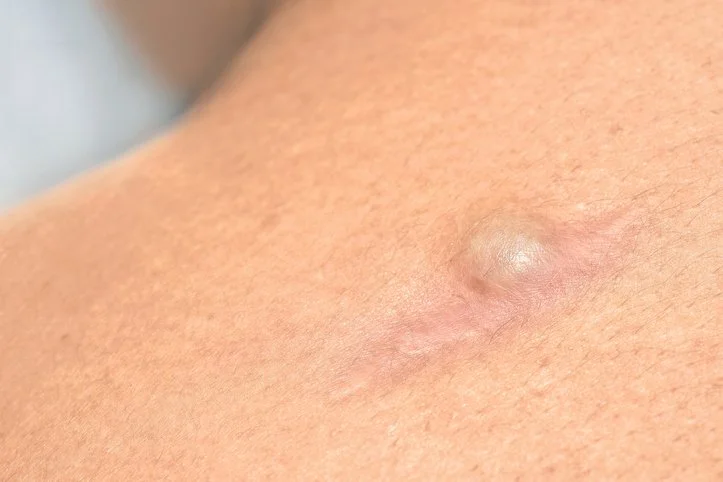
If you find a lump or bump on or under your skin and think it might be a cyst, you may wonder where to seek out care.
Dermatologists regularly diagnose and treat cysts and can also remove them when indicated. Because they specialize in skin, hair, and nail conditions, seeing a dermatologist is often the best first step if you notice a new or bothersome growth.
At Findley Dermatology, we can examine the area, determine whether it is a cyst, and recommend the best treatment based on its type, size, location, and symptoms.
What Is a Cyst?
A cyst is a sac-like growth under the skin that can contain fluid, keratin, or other material. One of the most common types is an epidermoid cyst, often called a “sebaceous cyst.”
Cysts can appear almost anywhere on the body, but they are commonly found on the face, neck, scalp, back, and trunk.
They usually appear as a round bump under the skin and can be very small or several centimeters wide. Some cysts remain the same for years, while others slowly grow or become sore, tender, or uncomfortable.
Do I Need to See a General Surgeon for a Cyst?
Most often not… and many people do not realize this.
Dermatologists are trained to diagnose and treat many types of cysts that form in the skin. Often, they can evaluate and treat cysts in their office. Seeing a dermatologist first has another important benefit: not every lump or bump is a cyst.
What looks like a cyst could actually be another type of harmless growth, such as an inflamed hair follicle, an abscess, a lipoma, or even a bony prominence like an osteoma. A fellowship-trained dermatologic surgeon has the proper training and experience to diagnose and treat these growths in the vast majority of situations.
Need to Be Removed?
No. If a cyst or other benign growth is small, not changing, and not causing discomfort, you may not need any form of treatment. In contrast, if a cyst does become painful, treatment with an injection and drainage may be indicated before definitive removal. You might want to have a cyst checked or talk about removal if it:
Becomes painful, red, swollen, or tender
Repeatedly becomes inflamed
Is growing or changing
Drains or ruptures
Catches on clothing or becomes irritated
Is in a location that causes discomfort
Bothers you cosmetically
Has never been evaluated and you're unsure what it is
Even if you do not want a cyst removed, it is wise to have any unexplained or changing lump evaluated rather than assuming it is harmless.
How Does a Dermatologist Treat a Cyst?
Treatment depends on the type of cyst and whether it is inflamed. If a cyst is irritated or inflamed, it may need conservative management before removal. Your dermatologist might suggest a topical medicine, an injection to reduce inflammation, or a small procedure to drain the cyst and relieve symptoms.
When needed, a cyst can also be removed with a minor surgery in the office using local anesthesia.
Draining a cyst and removing a cyst are not the same. Draining may provide relief, particularly if a cyst is painful or inflamed, but the cyst wall or capsule can remain beneath the skin. This means the cyst will likely eventually fill again. When the goal is definitive removal, the cyst wall in its entirety needs to be removed along with its contents to reduce the likelihood of recurrence.
What Is Cyst Removal Like?
For many common skin cysts, removal is a simple outpatient procedure. The area is numbed with local anesthesia, a small cut is made, and the dermatologist removes the cyst, taking proper care to visualize the entire cyst. Depending on its size and location, stitches are generally used to close the area.
You will receive instructions on how to care for the area and information about when to return for a follow-up or to have stitches removed, if needed. As with any procedure that involves a cut, some scarring is possible. Your dermatologist can explain what to expect based on the cyst's size and location before treatment.
Can I Pop or Drain a Cyst Myself?
It can be tempting, especially if the cyst looks like a large pimple, but squeezing, popping, or attempting to drain a cyst at home is not recommended. Doing so can irritate the area, contribute to an infection, and may lead to a more difficult procedure for complete removal in-office.
If a cyst is painful, growing, draining, or simply bothering you, it is best to have it evaluated by a professional.
Have a Cyst That's Bothering You? Let Us Take a Look.
Findley Dermatology offers evaluation and treatment for cysts and other common skin growths. Our team can determine what you are dealing with and discuss whether monitoring, medical treatment, or in-office removal is best for you.
Call Findley Dermatology today at (401) 415-8586 or request an appointment online to have your cyst or skin concern checked.